What If What You Wanted Is No Longer What You Really Want?

There are things we once wanted very clearly.
A certain kind of career. A successful business. More financial security. A better home. A particular way of living.
At the time, these things made sense.
Perhaps they represented progress. Perhaps they gave us something to aim for. Perhaps they were simply part of the life we imagined we would have one day.
And some of them may still be things we want.
But every so often, a different question appears.
Usually not dramatically.
Perhaps when the promotion finally becomes possible.
When the business reaches a point where it could become something much bigger.
When the savings have accumulated and upgrading the home is no longer a distant idea.
The thing we wanted is now within reach.
And instead of feeling only excitement, there is hesitation.
Do I actually still want this?
It can be a surprisingly difficult question to answer.
Not because we don't know ourselves.
Perhaps because we have spent so long assuming the answer was yes.
We don't always notice when our wants change
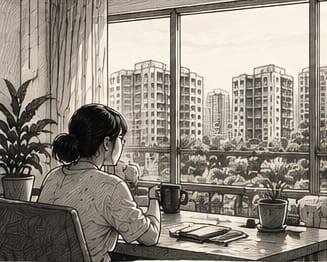
Some changes in us are obvious.
Others happen quietly.
What mattered greatly at 30 may occupy a different place at 40.
What once seemed worth sacrificing for may now compete with things we didn't value quite as much before.
Time.
Freedom.
Family.
Health.
Space.
The ability to change our minds.
Perhaps nothing happened to make the old ambition wrong.
Life simply gave us more information.
We discovered what certain choices actually ask of us.
We experienced things that we previously understood only from a distance.
We learnt what it feels like to have more responsibility. To earn more. To manage people. To run a business. To raise a family. To watch our parents grow older.
And somewhere among all of that, what matters to us may have shifted.
The strange thing is that our ambitions don't automatically shift with us.
They can remain exactly where we left them.
Waiting.
The things that once meant progress

There is a fairly familiar language of progress in Singapore.
Do well enough in school.
Find a good job, or build something of your own.
Earn more.
Save.
Invest.
Become more established.
Give the children opportunities.
Move into a better home when you can.
There are many versions of this life, of course. But most of us probably recognise something in it.
And there is nothing inherently wrong with any of these things.
A higher income can create security.
A successful business can create opportunity.
A promotion can be deeply fulfilling.
A more comfortable home can make everyday life better.
The difficulty isn't necessarily in wanting more.
Perhaps it begins when we stop noticing why we still want the next thing.
The next step appears.
It makes sense.
So we take it.
And then another.
After a while, something that began as a choice can start to feel like the natural order of things.
When the next step makes sense

Imagine you have done reasonably well.
Not extraordinarily well.
Just well enough that some of the things that once felt distant are now possible.
Perhaps a more senior position has opened up.
People around you assume you will go for it.
Why wouldn't you?
Perhaps your business has had a few good years.
There is an opportunity to hire more people, take on more customers, move into a larger space.
Again, why wouldn't you?
Or perhaps you and your spouse have accumulated enough savings and equity in your HDB flat that the conversation you have been having for years becomes more serious.
Maybe it's time to look at a condo.
So one Saturday, you visit a showflat.
The unit is beautiful.
The kitchen is nicer than yours. There is a balcony. The children would probably love the pool.
You can imagine coming home to it.
You begin doing the calculations.
What could we get for our flat?
How much would we need to borrow?
What would the monthly payment look like?
And eventually you realise something.
You probably can afford it.
That should settle the question.
But somehow it doesn't.
Because perhaps the question was never only:
Can we afford this?
There is another one underneath it.
What would choosing this require us to keep choosing?
Every choice contains other choices

We tend to think we are choosing one thing.
The promotion.
The larger business.
The new home.
The next financial milestone.
But perhaps we are rarely choosing only the thing in front of us.
The condo comes with a mortgage.
The mortgage assumes a certain level of income.
That income may assume you continue doing work that pays roughly what your work pays today.
And suddenly, a decision about a home is also connected to decisions you haven't made yet.
Whether you could take a lower-paying role that interests you.
Whether you could slow the business down.
Whether you could take six months away.
Whether you could say no more often.
Whether, five years from now, you could simply decide:
I don't want to do this anymore.
The choice was the home.
But hidden inside it were choices about work, time, freedom and how much uncertainty you would be able to tolerate later.
The promotion has its own hidden choices.
Perhaps the salary is better.
Perhaps the title means something to you.
Perhaps this is exactly the opportunity you once hoped would come.
But the role may also ask for more of your attention.
More decisions.
More responsibility for other people.
More evenings when something follows you home.
More moments when you are sitting at dinner but part of your mind is still in a conversation from three hours earlier.
You chose the promotion.
Did you choose those things too?
Perhaps you did.
Perhaps they are worth it.
But perhaps you never quite thought of them as part of the same choice.
The entrepreneur encounters another version.
The business is doing well.
There is room to grow.
Another employee. More customers. A bigger operation.
Growth feels like the natural response to success.
But growth creates its own commitments.
Salaries need to be paid.
Customers need to be served.
People begin depending on decisions you make.
The business you once wanted because it gave you freedom may eventually require you to protect the business before protecting that freedom.
None of this makes the home, the promotion or the larger business a bad choice.
That isn't the point.
The point is simply that every yes creates something that becomes harder to say no to later.
One choice begins leaning on another
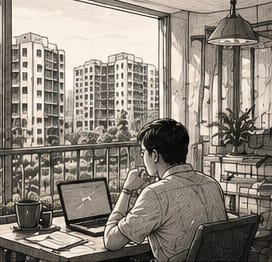
Perhaps this is why some choices become difficult to reconsider.
It isn't only because we once wanted them.
Other parts of our lives have begun to depend on them.
The home assumes the income.
The income assumes the work.
The work assumes the time.
The business assumes the customers.
The customers assume the team.
The team assumes the business continues.
One choice begins leaning on another.
Then another.
Until eventually we may find ourselves maintaining an entire arrangement that began with something we genuinely wanted.
And perhaps we still want it.
But sometimes what we once wanted requires us to keep wanting everything that comes with it.
That is a different question.
Perhaps you still want the home.
You're just less certain about the income you need to maintain it.
Perhaps you still love the business.
You're just less interested in the size it has become.
Perhaps you still care deeply about your career.
You're just no longer sure you want the amount of yourself the next stage asks you to give.
Perhaps you still value financial security.
You're just beginning to wonder how much security is enough before something else gets to matter more.
This is where things become less tidy.
Because sometimes we don't stop wanting the thing itself.
We stop wanting the arrangement of life required to keep it.
And that can take much longer to notice.
When success changes what success means

There is something curious about getting closer to the things we once wanted.
The view changes.
From a distance, we see the achievement.
Up close, we begin to see the life around it.
The senior position looks different once you have spent enough time around senior people to understand what their days actually contain.
Building a large company looks different once you understand what it feels like to be responsible for the livelihoods of twenty people rather than two.
The bigger home looks different when the question is no longer whether you could own it, but what owning it would mean for the choices available to you afterwards.
Perhaps this is not disappointment.
Perhaps it is perspective.
We are evaluating an old ambition with information the younger version of us simply did not have.
And perhaps that is exactly what we should be doing.
But I said this was what I wanted

Still, changing our minds can be uncomfortable.
Especially when other people know what we wanted.
Perhaps your colleagues assume you want the next position.
Perhaps your family has heard you talk about the plans for years.
Perhaps your friends know you have always wanted to upgrade.
Perhaps people around your business expect it to keep growing because that's what successful businesses are supposed to do.
And perhaps you expected these things of yourself too.
Then one day, you're no longer sure.
Was I wrong before?
Am I becoming less ambitious?
Am I giving up?
What will I do instead?
Sometimes continuing is easier than explaining why we might not.
And sometimes the person we find hardest to explain ourselves to is the person we used to be.
Perhaps you weren't wrong

Maybe you really did want it.
Not because society told you to.
Not because you were trying to impress anyone.
You simply wanted it.
The promotion mattered.
Building the company mattered.
The money mattered.
The home mattered.
Being able to provide more for your family mattered.
There is no need to diminish those wants simply because something feels different now.
They may have shaped some of the most important choices you made.
They may have pushed you into unfamiliar situations.
Given you confidence.
Created security.
Opened doors.
Changed what became possible for the people around you.
Perhaps the earlier version of you wasn't mistaken.
Perhaps that person simply had different needs.
And perhaps some of those needs have now been met.
The person who once needed security may begin to value freedom more.
The person who once wanted recognition may begin to value autonomy.
The person who wanted to prove they could build something may eventually realise that they have already proved it—to themselves, if nobody else.
Maybe changing what we want doesn't invalidate what we wanted before.
Perhaps it simply tells us that we have changed.
The pull of what we have already invested
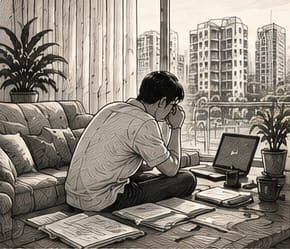
Old wants also become difficult to question because we have already given them something.
Time.
Money.
Attention.
Opportunity.
Perhaps years.
The more we have invested, the more uncomfortable it becomes to ask whether we would still choose the same thing today.
Because if the answer is no, another question appears.
Then what was all of that for?
But perhaps the past does not need to justify the future.
Those years were lived.
The experience was gained.
The relationships were formed.
The person asking the question today exists partly because of everything that came before.
Changing what we want next does not erase any of that.
We do not have to keep choosing something simply to prove that choosing it before was worthwhile.
Enough is difficult to recognise

There is always another level.
Another salary band.
Another title.
Another client.
Another revenue milestone.
Another property.
Another upgrade.
Another measure by which life can appear to be moving forward.
Progress is relatively easy to recognise.
Enough is much harder.
Enough doesn't announce itself.
There is no promotion letter for it.
No revenue target.
No property transaction.
No moment when someone taps us on the shoulder and says:
You have enough now. You can stop.
Perhaps that is why we sometimes pass it without noticing.
And maybe enough isn't the point at which we stop wanting more.
Perhaps it is the point at which something else begins to matter more than more.
Time.
Flexibility.
Attention.
Possibility.
The ability to change direction.
The ability to be present somewhere without another part of life constantly asking for us.
For someone else, enough may look completely different.
They may genuinely want the bigger company.
The senior leadership role.
The condo.
The next challenge.
There is nothing less thoughtful about choosing more.
And nothing inherently wiser about choosing less.
The interesting question is whether we can tell the difference between what we still want and what we have simply become accustomed to wanting.
Would you choose it again?

Perhaps there is one way to look at an old ambition differently.
Imagine, for a moment, that it had never been part of the plan.
Forget how long you have talked about it.
Forget what normally comes next.
Forget what other people might expect.
Stand where you are today.
With what you know now.
With the responsibilities you have now.
With the people who matter to you now.
With everything you have learnt about what gives you energy and what quietly takes it away.
And ask:
Would I choose this today?
Would I still want the promotion if declining it didn't look like a lack of ambition?
Would I still want the business to become much larger if staying smaller didn't look like a lack of success?
Would I still want the more expensive home if staying where I am didn't feel like standing still?
Would I still want the thing if nobody else could see that I had achieved it?
Perhaps the answer is yes.
And there is something meaningful in that.
Something you once wanted becomes something you are choosing again.
But perhaps the answer doesn't come as easily as it once did.
That doesn't necessarily mean anything needs to change.
It may simply mean something deserves your attention.
What if you don't know what you want instead?
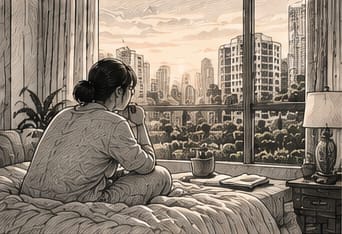
This may be the part we find hardest.
It is easier to reconsider an old answer when we already have a new one.
But often we don't.
We know only that something feels different.
If I don't want this anymore, what do I want?
Perhaps nothing immediately comes to mind.
There can be an urge to fill that space quickly.
Find another goal.
Make another plan.
Choose another direction.
But perhaps we don't need to.
There may be a period when we can see more clearly what no longer fits without yet knowing what will.
That doesn't necessarily mean we are lost.
Perhaps it simply means the old answer has stopped answering the question.
And for a while, that may be enough to notice.
Before you move on

Perhaps there is something you have wanted for a long time.
A career. A business. A home. A certain level of financial security. Or something only you would recognise.
There is no need to decide anything about it.
Just look at it again from where you are now.
If this had never been part of the plan, would you still choose it today?
And look beyond the thing itself.
What does having it require you to keep choosing?
The income. The pace. The responsibility. The time. The certainty.
Perhaps you would choose those things too.
Perhaps what you have built still fits the life you want.
But if you hesitate, perhaps the more interesting question isn't whether you still want what you once wanted.
It is:
What has become more important to you since you first wanted it?
And perhaps:
What are you no longer willing to trade for it?
There may be nothing to change.
Sometimes seeing an old choice with new eyes is enough.
Because what you wanted then may have been completely right for who you were then.
The question is whether you would still choose it as the person you are now.